
The Credential Problem: A Safety Certificate Can Tell You Almost Nothing
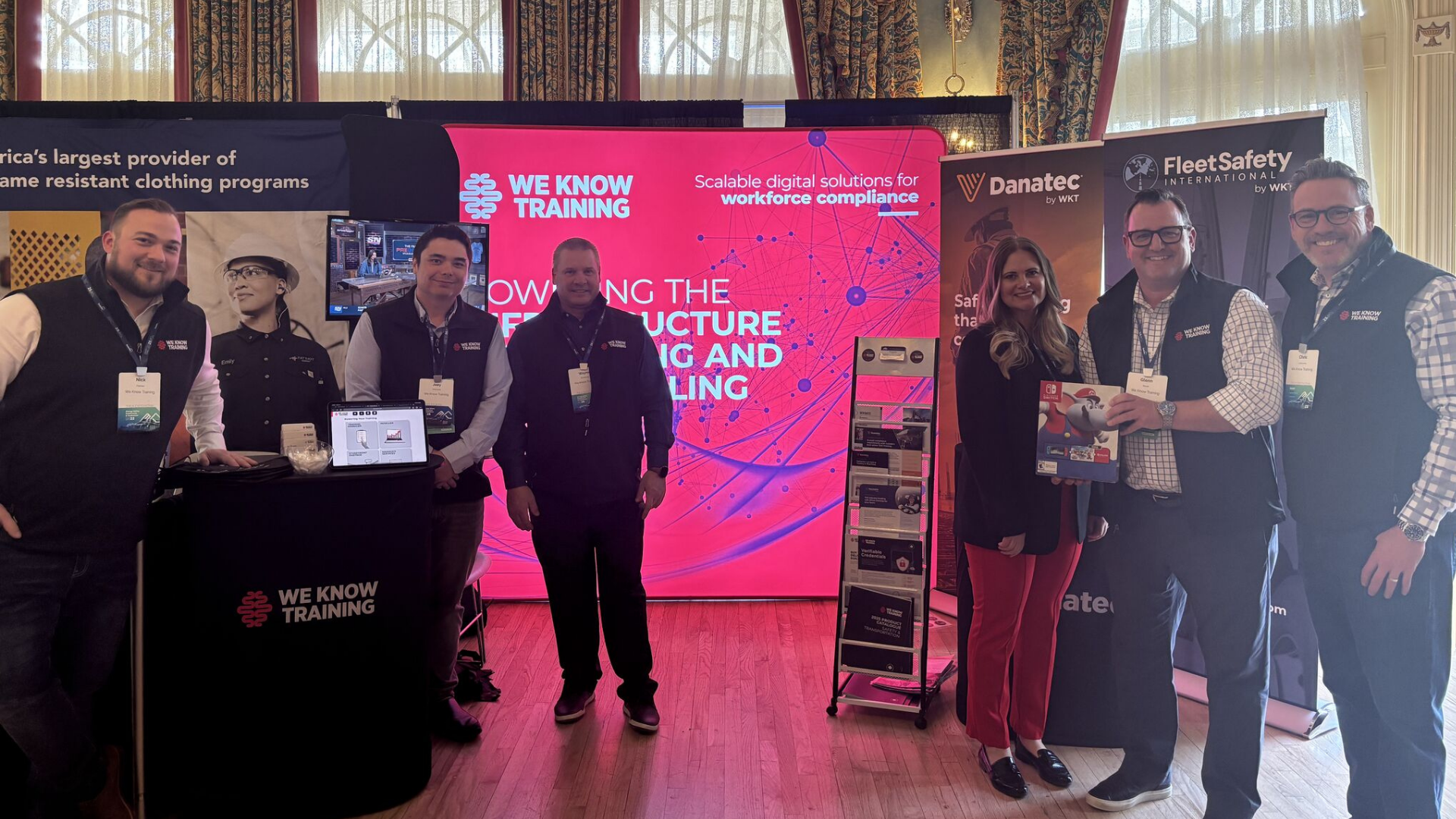
Here's our team from last year – just look for the bright pink booth again this year! Find us at booth 15!
A few months ago, an employer in Alberta was doing what any responsible employer should do before sending a crew into the field: validating ground disturbance certificates. Routine paperwork. The kind of administrative check that happens thousands of times a day across the country.
Except this time, something didn’t add up.
The certificate looked right. The logo looked right. Even the email confirming it looked right. It appeared to come from a legitimate training provider’s domain, with a professional signature block and a PDF attachment that opened cleanly. But when the employer dug a layer deeper, the entire chain unraveled. The email domain was a near-perfect spoof. The certificate number didn’t exist in any registry. The training provider reference was fabricated. The worker named on the credential had never sat through the course.
It was a forgery. A good one. And it almost worked.
This is not a one-off
We wish we could tell you this was an isolated incident. It isn’t. Across Canada, counterfeit safety training certificates are circulating at a scale and sophistication the industry has been slow to acknowledge. Some are crude PDFs with mismatched fonts. Others are nearly indistinguishable from the real thing, complete with QR codes that resolve to convincing fake landing pages.
The uncomfortable truth is that the paper certificate sitting in a worker’s binder, or the PDF attached to an onboarding email, was never designed to prove what we ask it to prove. It is a record that someone issued a document. It is not proof that the right person took the right training and demonstrated the right competencies.
A safety certificate, on its own, tells you almost nothing.
Three failures hiding in plain sight
When you take apart a typical safety credential, three structural failures appear.
No proof of identity.
A name on a certificate is just a name. There is no cryptographic link between the credential and the human being it claims to represent. A determined fraudster can rename, reuse, or fabricate at will.
No proof of presence.
The credential says training happened. It does not, and cannot, prove that the named individual was actually present, engaged, and assessed. Sit-ins, ghost completions, and shared logins are well-documented problems in self-paced training.
No proof of training.
The certificate testifies that a course was completed. It rarely conveys what was actually demonstrated, by whom, against what standard, and whether the issuing body even has the authority to attest to it.
Stack those three failures on top of one another and you have a system where a convincing forgery is not difficult to produce, and a legitimate credential is not meaningfully different from a fake at the moment of verification.
Why this matters now
The construction, energy, transportation, and utilities sectors run on trust in credentials. A worker shows up at a site. A supervisor checks a card or a PDF. Work proceeds. Multiply that interaction across every contractor, every shift, every jurisdiction, and the system’s reliance on unverifiable paper becomes staggering.
When a credential fails, the consequences are not administrative. They are operational, regulatory, and human. OH&S investigations, project shutdowns, contractor disqualifications, and in the worst cases, incidents that should never have been possible.
Employers feel this pain first. Workers carrying real credentials feel it next, because legitimate training gets devalued every time a fake one slips through. Training providers feel it as their reputations get used as cover for credentials they never issued.
What comes next
The good news is that the technology to fix this is closer than most people think, and the standards are maturing fast. Identity-anchored verifiable credentials (credentials tied to the person who earned them, verifiable in seconds without phoning anyone) are moving out of the research phase and into real-world deployment.
At WKT, we have the technology that goes into the credentials our learners earn through Danatec and our partners. These won’t just be records on a server somewhere. They will be portable, tamper-evident proofs that a worker can carry, an employer can verify in seconds, and a regulator can trust.
We’re bringing this conversation to Banff
We Know Training, Danatec, and Fleet Safety International will be at the Energy Safety Canada Conference 2026 at the Fairmont Banff Springs Hotel, April 27–30. Here is how we’re showing up.
Booth 15: April 27–30
Come meet the teams behind 2M+ certifications and 1M+ unique learners across Canada’s regulated industries. We’ll be on the floor all four days to talk safety training, workforce compliance, and the business solutions we’ve built for organizations that train at scale. Enter the draw for a chance to win a Nintendo Switch 2.
Workshop Sponsorship: From Planning to Protection, April 27
12:30–4:00 PM | Shaughnessy, Fairmont Banff Springs
We Know Training is proud to sponsor Workshop 3 at this year’s conference. Led by Dr. Siddarth Bhandari of the Construction Safety Alliance, this four-hour session introduces a science-based framework for safety planning, execution, and post-event learning using three integrated tools: pre-task meetings, HECA, and the SCL model. Designed for safety leaders, supervisors, and operational teams who want practical, field-ready methods.
Safety Talk: The Credential Problem, April 28
11:00 AM | Hotel Side, Mezzanine 2, New Brunswick/Alberta Alcove
Joey Motokado, Director of Market Development, will walk through a real fraud case from start to finish. He’ll unpack the structural gaps in paper-based credentialing and challenge the audience with a live exercise: can you spot the fake certificate? This talk is for anyone responsible for knowing that the workers on their site are actually trained.
Bring your skepticism. Bring your hardest questions. The credential problem is solvable. But only if the industry decides, together, that “it looked right” is no longer good enough.
Energy Safety Exchange (Invite-Only), April 29
5:00–6:00 PM | Upper Rundle Bar, Fairmont Banff Springs
We’re closing out the conference with an invite-only networking mixer on Wednesday evening. Join the WKT and Danatec leadership team for drinks and appetizers, and the kind of conversations that don’t happen on the tradeshow floor. Space is limited. To request an invitation, contact Nicole Ralph, VP of Revenue, at nicole.ralph@wkt.ca.
Come see the real version
If any of this lands close to home, if you have ever stared at a certificate and wondered how you would actually know, come find us in Banff.
Stop by Booth 15. Catch the Safety Talk on April 28. And if you want to set up time with our team before the conference, fill out the form on our event page and we will be in touch.
Connect with our team at the conference:
WKT and Danatec have spent decades building safety training Canadian industry relies on. We are now building the credentialing infrastructure that training deserves.
Frequently Asked Questions
-
Credential fraud occurs when a person presents a forged, altered, or fabricated training certificate to an employer or regulator. In safety-critical industries, this means a worker may be on-site without the training required under provincial occupational health and safety legislation.
-
Energy Safety Canada identified 178 counterfeit safety training certificates in a nine-month period in 2024 alone. Industry reports from 2026 describe a surge in fake training certificates. The cases that get caught represent only what the most diligent employers identify. The actual volume is far higher.
-
Current methods include contacting the training provider directly, checking provider-specific verification portals, or accepting paper and PDF certificates at face value. None of these methods scale, and none of them provide a reliable answer at the point of need: at the gate, during an audit, or in the aftermath of an incident.
-
Yes. We Know Training, Danatec, and Fleet Safety International will be at Booth 15 at the Fairmont Banff Springs Hotel, April 27–30. The team is hosting a Safety Talk on credential fraud on April 28 at 11:00 AM and an invite-only networking mixer on April 29.
-
The Safety Talk is an open conference session. If you are attending the Energy Safety Conference, it takes place April 28 at 11:00 AM in the Hotel Side, Mezzanine 2, New Brunswick/Alberta Alcove. No separate registration required.
-
The Energy Safety Exchange on April 29 is invite-only and space is limited. Contact Nicole Ralph, VP of Revenue, at nicole.ralph@wkt.ca to request an invitation.